Circular Economy · September 2026
The Next Mine Is in Your Data Center. Most Companies Are Still Throwing It Away.
By EcoGreen Solutions
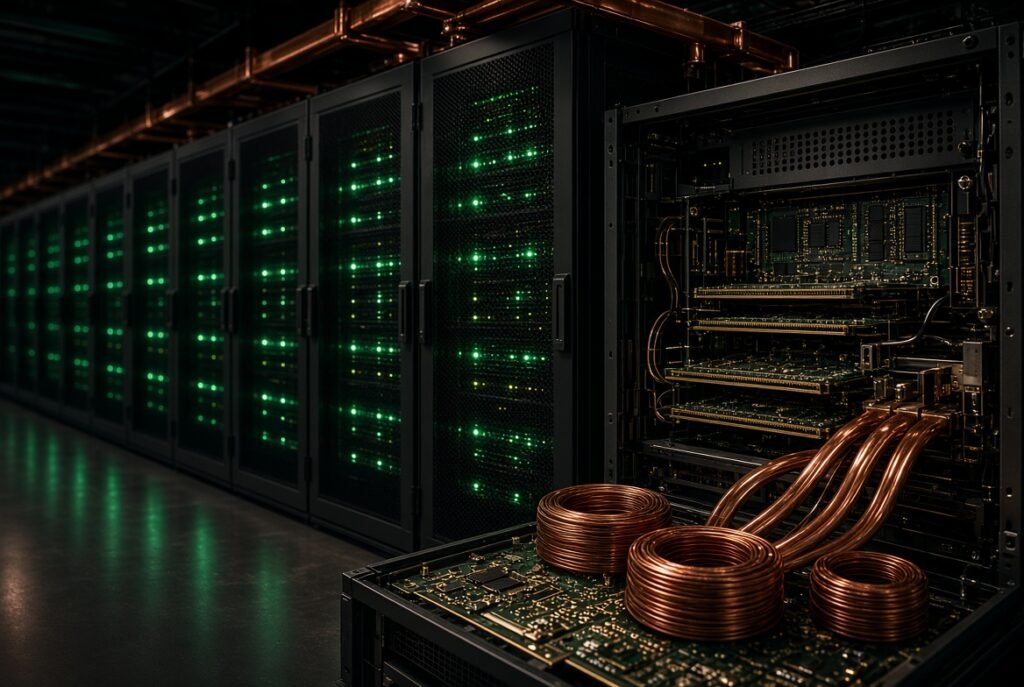
An AI-optimized data center floor consumes roughly 43–50 tonnes of copper per megawatt. A single 1-gigawatt “AI factory” eats up to 50,000 tonnes of copper — enough to make grid planners and mining ministers nervous.
Copper is not the only bottleneck. Rare earths, lithium, cobalt, palladium, gold, silver — they all sit locked in GPUs, hard drives, magnets, and power gear. The International Energy Agency warns of a supply deficit that could reach 30% by 2035. New copper mines take 19 years to develop. AI racks take 18 months.
The gap between what the world needs and what mines can supply is growing faster than either can solve it. But there is already a solution sitting in your data center cage, your storage closets, and your retirement stacks. Most organizations are still throwing it into a dumpster.
The Pile Is Already Enormous
The world generated 62 million tonnes of e-waste in 2022. Only 22.3% is documented as properly collected and recycled. Generation is rising about five times faster than documented recycling can handle. By 2030, the pile is headed past 80 million tonnes.
The metals in that e-waste were worth $90 billion in 2022. But only $28 billion was recovered. The rest leaked — into landfills, informal yards, and secondary markets with no chain of custody.
AI Is Making It Worse, Fast
When AI lands in enterprises — across clouds, offices, and data halls — it does something specific: it accelerates the death of last-generation hardware. A 3-year-old server that was “still useful” gets retired for a newer, faster model. A GPU cluster that worked fine gets swapped out for the latest generation. The Basel Action Network’s 2026 research projects 395 to 617 million tonnes of AI-linked electronic equipment will be retired between 2025 and 2050.
Annual global e-scrap is heading toward 200 million tonnes — more than triple today’s flow. That is the contagion obsolescence problem: AI does not just create new demand for minerals. It orphans the equipment that could recover them.
The richest untapped mine on the planet is not in the ground. It is in the server racks organizations are retiring right now — and the clock is ticking before that equipment gets buried, exported to informal yards, or sold into undocumented secondary markets where the metals vanish.
Why This Matters to Your Bottom Line and Your Board
The Supply Crunch Is Real. AI data centers could consume more than 500,000 metric tons of copper annually by 2030. Meeting that demand would require $210 billion in new mining investment — but only $76 billion was invested over the prior six years. Large, high-grade copper deposits are becoming rarer; only four major discoveries occurred globally between 2019–2023.
Recycled Materials Are Now Strategic Assets. The IEA projects that by 2050, recycling could supply nearly 40% of copper demand and 20–30% of lithium, nickel, and cobalt demand. That is not environmental virtue signaling. That is supply-chain insurance. Microsoft already ran a U.S. pilot: 50,000 pounds of obsolete data-center hard drives, pulling neodymium, praseodymium, and dysprosium back out instead of buying them on a hostile market.
Your Retired Equipment Still Has Value — If You Prove It. Devices retain 65–70% residual value after three years. High-end GPUs and servers remain functional and attractive to secondary markets. But secondary value vanishes the moment chain of custody breaks. A certified, documented resale stream is worth money. An undocumented pile is worth nothing — and it is a liability.
ESG Reporting Just Got Teeth. Scope 3 emissions now include end-of-life device disposal. Regulators are moving from “we recycled it” to “prove it.” NIST 800-88 is table stakes. Serial-level destruction certificates are expected. The companies that can show auditors a full-chain provenance record—from purchase through secure decommissioning to certified resale or destruction—are the ones passing audits. The ones that cannot are getting questions from compliance, board members, and potentially regulators.
What Urban Mining Actually Looks Like
Urban mining is not a metaphor. It is a documented supply chain where organizations treat retirement as a four-step extraction process:
The Moat: Companies That Document Win
The 2026 shift is obvious: the companies controlling documented streams of retired IT will be the ones sitting on inventory the world is about to bid for. Every kilogram of copper, lithium, and rare earth recovered with proof is worth more than undocumented scrap.
EcoGreen Solutions does all four steps — assess, modernize, secure, recover — as a single process. Already recovered $1.2M+ for clients, with full documentation. That number is no longer “we found you some residual value.” It is:
We extracted money and materials from the mine you already paid for, with proof you can show a board, an auditor, and a regulator.
That is the business model competitors cannot replicate, because they leave when the cutover party ends. EcoGreen stays.
The world is running out of copper. But you are full of it. EcoGreen Solutions helps enterprises turn retiring infrastructure into documented urban mines — recovery, not disposal. Board-ready audits. Regulatory proof. Real money back. Let’s make your data center a strategic asset.
Join the conversation:
Ready to see where our approach has actually been tested?
Reach out and we’ll walk you through the exact case studies behind every phase of what we do.
Get a Free Assessment