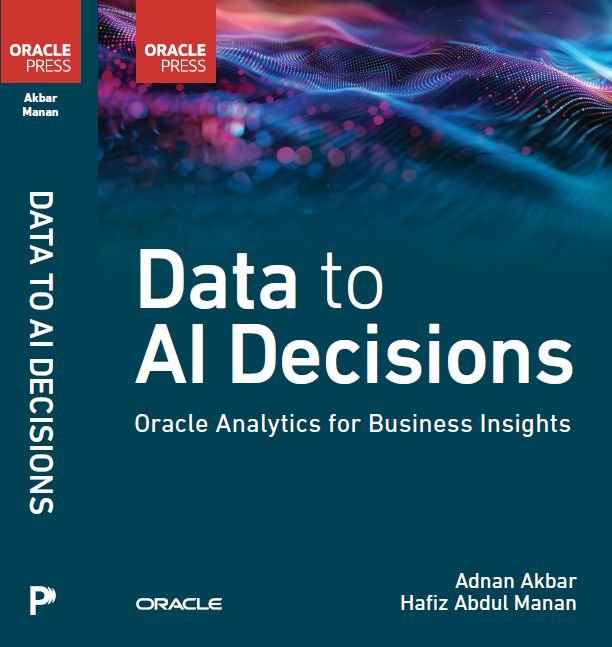
There are career milestones. And then there are milestones that put your work into the hands of an international technology audience.
For Hafiz Abdul Mannan, CTO of EcoGreen Solutions, co-authoring Data to AI Decisions: Oracle Analytics for Business Insights is one of those moments.
Published under the Oracle Press imprint by Pearson—one of the world’s largest educational and professional publishing companies—the book takes on a subject that sits directly at the intersection of enterprise analytics, data management, visualization, machine learning, and business decision-making.
For a Pakistani technology professional, seeing that level of technical work reach an international publishing platform is something worth recognizing. It represents more than just a publication. It represents expertise being translated into a resource that technology leaders globally can learn from.
But what impressed me most was not simply the achievement of having a book published. It was where the book begins.
Where the Book Starts Matters
I started with Chapter 1. And instead of immediately jumping into AI, machine learning, or impressive-looking dashboards, the authors begin with something much more fundamental:
The Web Catalog.
That choice says a lot about the way the subject is being approached. Because enterprise analytics does not begin with a beautiful dashboard. It begins with structure, access, organization and control.
This is exactly the kind of disciplined thinking that separates a book about features from a book about systems.
The Foundation Behind the Dashboard
In Oracle Analytics Server, the Web Catalog serves as the central environment where analytical assets are organized and managed. Think of it as the operating system of an analytics infrastructure.
Within this catalog live:
- Dashboards
- Datasets
- Data flows
- Narratives
- Machine learning models
These are not simply files sitting somewhere in a folder. They are assets that can become part of an organization’s decision-making infrastructure. And once analytics becomes part of enterprise operations, an important question appears:
Who should be able to see, modify, share or manage those assets?
That is where permissions become much more than an administrative setting. They become part of analytics governance.
Three Questions That Scale Poorly
A useful way to think about the chapter is through three deceptively simple questions:
- 1. What exists? What analytical assets does the organization have?
- 2. Who can access them? Who can view, modify, share or manage those assets?
- 3. Where should they belong? Should they remain personal, be shared with a team, or sit within an organizational structure?
Those three questions sound simple when you’re managing 10 dashboards. At enterprise scale—when you’re managing thousands of analytical assets across hundreds of users, multiple teams, and different business units—they are anything but simple.
And this is where the book’s approach becomes valuable: it treats governance not as a constraint, but as a necessary part of building analytics systems that actually scale.
Personal Work vs. Organizational Control
One of the practical strengths of the chapter is how it explains the different organizational areas within the catalog. The book walks through:
- Private workspaces — Room for individual experimentation and personal analysis
- Shared environments — Enable team collaboration and knowledge sharing
- Custom organizational structures — Allow businesses to create arrangements that fit their own operational requirements
That distinction matters more than it might initially appear.
Analytics teams constantly operate between two competing needs: individual flexibility and organizational control. Too much restriction can slow people down and stifle innovation. Too little control can create confusion, duplication of effort, and serious security problems.
A well-structured analytics environment has to support both simultaneously. That is the kind of foundation that becomes increasingly important as organizations move toward larger data environments and AI-assisted decision-making.
Why This Opening Chapter Is More Important Than It First Appears
At first glance, a chapter about a catalog might not sound like the most exciting opening for a book about data and AI. I would argue the opposite.
It demonstrates discipline in thinking.
Before asking what AI can predict, organizations need to understand the data and analytical assets they already have. Before people can collaborate effectively, they need to know where those assets live and who has access to them. Before insights can be trusted, access and ownership need to be considered carefully. And before an organization can scale analytics, it needs a foundation that can actually support that scale.
That is a much bigger idea than simply learning where to find a dashboard. It’s about understanding what makes analytics sustainable at scale.
What Makes This Book Valuable
The real value of a technical book is not how many features it can list or how many screenshots it can include. It is whether it helps the reader understand how those features fit into a larger system.
That is what distinguishes a feature manual from a strategic guide.
From what I can see in the opening chapters, Data to AI Decisions is clearly attempting the latter. The book is not merely about producing visualizations or configuring dashboards. It is about understanding the environment in which data becomes analysis, and analysis becomes a business decision.
And that journey starts with fundamentals. Not the exciting part. The essential part.
Why This Matters for EcoGreen
For EcoGreen Solutions, this publication reinforces something we believe strongly: enterprise technology is about complete systems, not isolated components.
In our work managing complete data lifecycles—from legacy infrastructure through cloud modernization to secure retirement—we see the same pattern repeatedly:
Organizations that succeed are not the ones with the fanciest technology. They are the ones that understand and control their foundations.
Whether it’s analytics governance (as Abdul Mannan describes in his book) or data lifecycle management (as we practice in our work), the principle is the same:
Abdul Mannan’s book is about understanding the foundation of analytics. Our work is about understanding the foundation of data management. Different domains, same principle.
Recognition Worth Acknowledging
For Hafiz Abdul Mannan, this is also more than another technical publication. It represents years of technology experience being translated into something other professionals can learn from—and benefit from.
In a global technology landscape where published expertise often comes from a narrow set of countries and companies, seeing a Pakistani technology professional reach an international publisher like Pearson/Oracle Press is something worth recognizing.
It represents:
- Deep technical expertise being recognized globally
- Knowledge from different regions and perspectives enriching the field
- Proof that excellence in technology is not geography-dependent
- An example for other technology professionals in Pakistan and South Asia
What Comes Next
The real test of a technical book is whether it actually influences how organizations approach problems. I’ll be continuing through Data to AI Decisions and sharing some of the ideas that stand out along the way.
If you work with Oracle Analytics, enterprise data, business intelligence, analytics strategy, or AI-driven decision-making, this is a book worth putting on your reading list.
Not because it has all the answers—no book does. But because it approaches the subject with the discipline of someone who understands that lasting systems are built on solid foundations.
📚 Data to AI Decisions: Oracle Analytics for Business Insights
Published by Pearson | Oracle Press Imprint
Author: Hafiz Abdul Mannan (Co-author)
Subject: Enterprise Analytics, Data Management, Machine Learning, Business Intelligence
Available through: Pearson Publishing
Building analytics systems? Managing enterprise data? Scaling your data infrastructure?
EcoGreen Solutions helps organizations build complete data lifecycles—from governance and optimization to secure retirement and recovery. Let’s talk about your data foundation.
Schedule a ConsultationChapter 1 may be about the Web Catalog, but the bigger lesson is much broader: Systems beat features. Foundations beat flashiness. And discipline beats hype.
That principle applies across enterprise technology—and it’s something worth remembering.