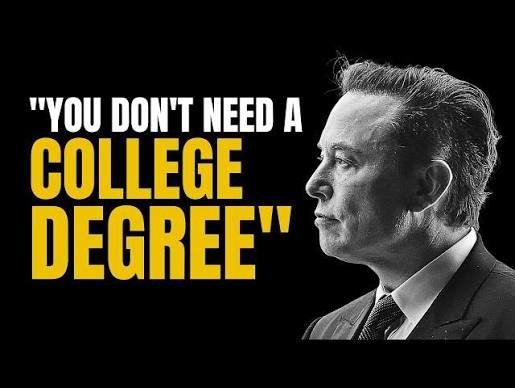
Elon Musk Says Skip the Degree. He’d Never Skip This Certificate.
Musk’s hiring philosophy is blunt: prove you can do the work, and nobody cares about your diploma. He’s right — about hiring people. But the moment the conversation shifts from “who do we hire” to “who do we trust with our data,” the entire logic flips, and the credential that actually matters is one almost nobody checks.
A clip of Elon Musk explaining why he doesn’t care about college degrees has been making the rounds again — skills, curiosity, and execution over formal credentials. It’s a genuinely good point, and it’s not just a soundbite. Musk has said it consistently, in almost the same words, for years.
What Musk actually said
Talking about hiring for Tesla’s AI team, Musk laid out the bar in five words that have since been quoted everywhere:
“A PhD is definitely not required. Don’t care if you even graduated high school.” — Elon Musk, on hiring for Tesla’s Autopilot/AI team
The line right after that one matters just as much, because it’s not “anything goes” — it’s a different, harder bar:
“Educational background is irrelevant, but all must pass hardcore coding test.” — Elon Musk
He’s made the same point at events like the Air Force’s Space Pitch Day, distilling it into a question he says he actually asks about every candidate: what did they do that’s clear evidence of exceptional ability? Built something impressive. Won a hard competition. Shipped a working solution to a real problem. He’s even needled the hiring process itself, asking whether someone like Nikola Tesla — no formal engineering degree, by the standards of the day — would get an interview at most companies today.
He’s right. For hiring a person.
This isn’t a fringe take anymore. Apple and Google both dropped degree requirements for large swaths of technical roles years ago, and the research Musk is implicitly leaning on is real: the correlation between “has a diploma” and “is good at the job” is weaker than most hiring processes pretend it is. If someone can pass Tesla’s coding test, or point to something they actually built, that’s a stronger signal than a transcript.
So far, so good. The problem is what happens when people quietly stretch that same logic somewhere it doesn’t belong.
The certificate Musk would never skip
Here’s the flip. “Skills over credentials” is a philosophy about hiring a person to build something. It says nothing about who you hand your company’s retired laptops, servers, and hard drives to when they’re done. That’s not a talent question. It’s a chain-of-custody question — and it’s exactly the kind of thing formal certification exists for, because “trust me” isn’t verifiable, auditable, or defensible in front of a regulator.
Put it this way: Musk doesn’t care if the engineer who wrote Autopilot’s code has a degree. He’d care very much whether the vendor hauling away SpaceX’s or Tesla’s decommissioned servers can produce a serial-number-level, third-party-audited Certificate of Destruction — because if they can’t, there’s no way to prove customer data, source code, or internal documents didn’t just walk out the door on an unwiped drive.
That’s the distinction that gets lost every time this clip goes viral: skills can be demonstrated. Data destruction has to be certified, because by definition nobody can inspect it after the fact.
Those numbers, from IBM’s 2025 Cost of a Data Breach Report, are for breaches generally — phishing, credential theft, misconfigured cloud storage, third-party access. Retired hardware is one more door into that same house, and it’s the door most companies forget to lock, because once a laptop is “old,” it stops feeling like a security asset and starts feeling like junk. It isn’t. Every device that leaves your building with a working drive is a live liability until someone can prove, on paper, that it isn’t anymore.
What real certification actually requires
- NAID AAA — background-checked and drug-screened personnel, video-monitored chain of custody from pickup to destruction, unannounced third-party audits, and a serial-number-tracked Certificate of Destruction.
- R2v3 — a formal Data Sanitization Plan aligned to NIST 800-88 / IEEE 2883-2022 destruction standards, plus downstream tracking so nobody can lose materials into an unaccountable supply chain.
Neither of those is a piece of paper you frame on a wall. They’re operational disciplines that a vendor either does or doesn’t actually run — and that’s the entire point: certification exists precisely because “we’re careful” isn’t something you can verify from the outside. A degree is a proxy for a skill you could, in theory, test directly. A destruction certificate is the test.
Where this actually lives: the EcoGreen Data Lifecycle Framework
This is the exact gap our clients ask us to close — not “help us hire smarter,” but “prove, on paper, that our retired infrastructure never becomes someone else’s data breach.” We built our entire service around treating every device’s end-of-life as seriously as its purchase, through one exclusive, end-to-end framework: Audit → Classify → Optimize → Retire → Recover. Not a checklist stitched together from separate vendors — one accountable chain from the moment a device is flagged for retirement to the certificate that proves it’s gone for good.
Get a Free Assessment- AuditMap what you have
- ClassifySort by risk & value
- OptimizeRight-size storage & cost
- RetireCertified destruction
- RecoverValue + ESG impact
The services behind the framework
Data Lifecycle Management
Governance and compliance across every stage a piece of data or hardware goes through — creation to modernization to secure retirement.
Secure Data Disposal & Compliance
Certified destruction with serial-number chain of custody, so “we wiped it” is a documented fact, not a claim.
Asset Recovery & ESG Impact
Retiring infrastructure doesn’t have to be a cost center — recovered value and diverted e-waste both count toward the bottom line.
Cybersecurity & Resilience
The same discipline that protects live systems has to extend to the systems you’re taking offline for good.
FAQ
Isn’t “wipe the drive” good enough?
Only if you can prove it happened, to whom, and when. A verbal assurance from whoever hauls away your old equipment isn’t evidence in an audit, a breach investigation, or a regulator’s inquiry. A serial-number-tracked Certificate of Destruction is.
Does this apply to small businesses, or just enterprises?
Breach costs scale down, not away — a smaller company has less room to absorb even a modest incident. The certification requirement is the same regardless of company size; what changes is how much a lapse actually costs you.
What’s the actual difference between R2v3 and NAID AAA?
R2v3 is broader — it covers responsible recycling and downstream material tracking generally, with data sanitization as one requirement among several. NAID AAA is specifically a data-destruction standard, built around continuous, unannounced audits of the destruction process itself. A vendor holding both is proving two different things: that materials are handled responsibly, and that data never survives the process.
Sources: Musk’s “exceptional ability” hiring standard, FEE · Musk on Tesla AI-team hiring, Inc. · IBM Cost of a Data Breach Report 2025, Help Net Security · NAID AAA requirements, CTL · R2v3 & NAID AAA standards, human-I-T
Ready to see where our approach has actually been tested?
Reach out and we’ll walk you through the exact case studies behind every phase of what we do.
Get a Free Assessment