Data Center Infrastructure · Asset Recovery · October 2026
AI Data Center Construction Delays: How Stranded Infrastructure Costs Millions While You Wait
Substrate shortages and backend assembly bottlenecks leave equipment depreciating. Recover 40–55% value before it vanishes.
By EcoGreen Solutions
Table of Contents: The Real Bottleneck · Stranded Assets · Recovery Strategy · Financial Impact
The data center buildout bottleneck stopping your AI infrastructure expansion is not what you think it is.
You have the GPUs. You have the semiconductor chips. You have the capital. But your AI data center facility is sitting 50–70% complete because of something the industry did not predict: substrate shortages, interconnect fabric delays, liquid cooling system constraints, and power grid connection backlogs are now the actual supply chain choke points — not silicon fabrication.
According to the latest semiconductor supply chain analysis, the constraint has cascaded upstream: advanced packaging substrates, backend assembly capacity, and system-level infrastructure (cooling, networking, power integration) are what’s blocking final delivery. Solving one bottleneck just exposes the next. That leaves enterprises in a painful position: billions locked in incomplete infrastructure, old equipment still depreciating in warehouses, and no clear end date.
But there is a hidden cost nobody is accounting for. And it’s your competitive advantage if you act now.
The Stranded Asset Trap: Equipment Depreciation During Build Delays
Here’s what happens when your data center build gets stuck in the substrate queue:
Year 1: You buy new interconnect fabric, liquid cooling systems, advanced power distribution equipment. State-of-the-art. Cost: millions.
Year 2: Build delays. Those systems sit in warehouses. Other technology moves faster. By the time your facility is ready to deploy, that gear is already one generation behind. Resale value drops 30–45%. Still depreciating on the books.
Year 3: You finally get substrate allocation. But you have a choice: deploy the now-dated equipment you bought three years ago, or replace it with current generation. Either way, you’re losing money. The old stuff gets scrapped or dumped into secondary markets with zero documentation of value or provenance.
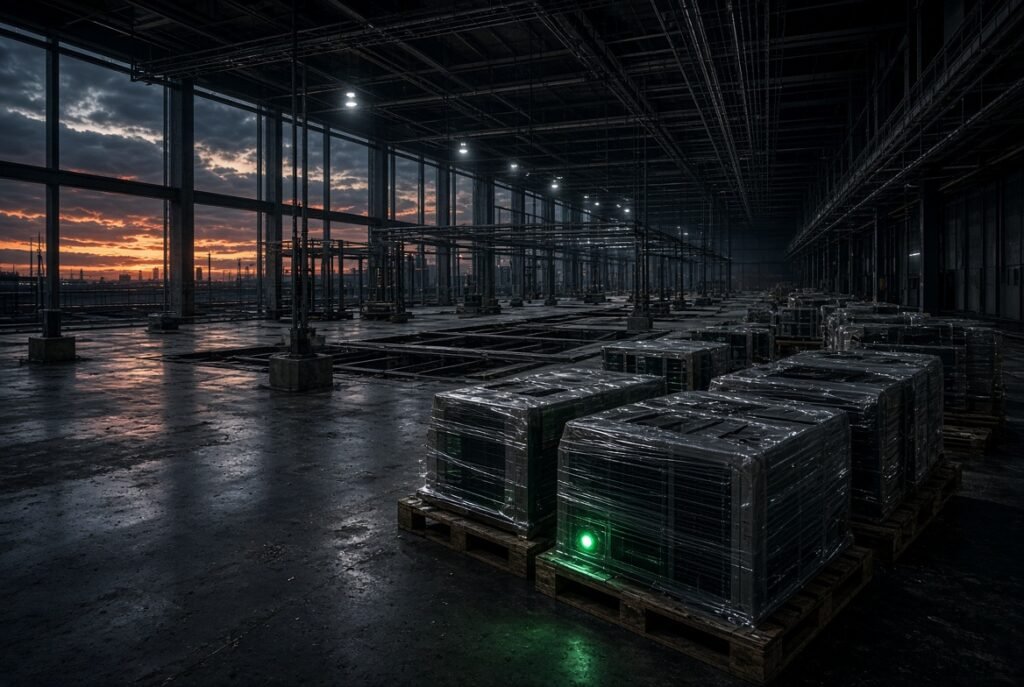
Every month your data center sits incomplete, equipment depreciates. Every month you wait for interconnect fabric or substrate allocation, your cooling systems become last-generation. The longer the bottleneck persists, the more value bleeds away — and most companies have no process to capture that loss before it vanishes.
What the Bottleneck Really Looks Like: Substrate Constraints & System Assembly Delays
The Gap Is Structural, Not Temporary. October 2026 data shows Morgan Stanley projecting 3 million TPU v9 units by 2028, but substrate constraints could cut that to 2 million — a 33% miss. That is not a one-quarter delay. That is a structural capacity problem that compounds across the industry.
It’s Cascading. Substrate shortages cascade into IC packaging delays, which cascade into server integration bottlenecks, which cascade into facility power grid connection queues. Solving one problem exposes the next immediately. Your facility sits waiting on power infrastructure. Your old networking gear sits unused. Your backup cooling capacity becomes a liability instead of an asset.
It’s Invisible to Accounting. Most enterprises haven’t modeled the total cost of stranded infrastructure during build delays. Equipment depreciates. Refresh cycles accelerate. Older generations get orphaned. Nobody has chain-of-custody documentation showing what happened to the gear that was staged for deployment but never needed. When you finally ask “where’s that $5M cooling system we bought in 2024?”, the answer is murky.
The Hidden Opportunity: Asset Recovery & Liquidation Strategy
The companies that will come out ahead of this bottleneck are not the ones waiting passively. They are the ones treating their stranded infrastructure as a liquidation opportunity, not a sunk cost.
Step 1: Audit Your Stranded Inventory. Before the substrate crunch lifts, document everything sitting in your staging areas: cooling systems, interconnect fabric, power distribution, backup capacity, older-generation networking gear. Most organizations don’t know what they have, where it is, or what it’s worth.
Step 2: Capture Residual Value Now. Equipment that’s one year old retains 60–70% of its value. Equipment that’s three years old retains 30–40%. Every month you wait to make a disposition decision, that percentage drops. The companies acting now are moving last-generation gear into secondary markets, recovering 40–55% of cost before it becomes worthless.
Step 3: Document the Entire Chain. If you’re going to recover value from stranded infrastructure, you need provenance. Serial numbers. Purchase dates. Maintenance history. What happened to it during storage. Where it went. That documentation is what separates a legitimate secondary-market sale (40–55% recovery) from undocumented scrap (5–10% recovery).
Step 4: Refresh with Current Generation (with Proof). Once you’ve liquidated the stranded gear, you can deploy current-generation equipment when substrates finally arrive — with full chain-of-custody documentation from day one. That equipment won’t be orphaned by the next bottleneck.
Financial Analysis: The Cost of Stranded Infrastructure vs. Active Asset Recovery
Scenario A: Wait Passively
Stranded equipment: $15M. Current generation: 65% of original value. In 12 months: 50% of original value (30% loss). In 24 months: 35% of original value (65% loss). By the time you liquidate, you’ve lost $5–10M.
Scenario B: Act Now
Stranded equipment: $15M. Document and move to secondary markets with 45% recovery ($6.75M recovered). Deploy current-generation equipment when ready. Retain $6.75M in value instead of losing $5–10M. Net difference: $11–16M.
That is not a rounding error. That is the difference between a balanced budget and a major loss.
Why Chain-of-Custody & Formal Asset Management Matters
Keywords: data center asset recovery, equipment lifecycle management, stranded infrastructure, IT asset liquidation, supply chain delays, equipment depreciation, secondary market resale, ITAD (IT Asset Disposition), inventory management, value recovery
The companies that will recover value fastest are not the ones that try to handle this in-house. They are the ones that treat stranded infrastructure as a specialized problem requiring:
That process is exactly what EcoGreen’s Data Lifecycle Framework handles — not for retired assets at end-of-life, but for equipment trapped in the middle of its economic life due to infrastructure delays.
The substrate bottleneck will not break overnight. That means every month you wait, stranded infrastructure depreciates further. The companies that move now are the ones that will recover millions while competitors watch value leak away.
Stop the depreciation. Your data center construction delays are costing millions monthly in equipment value loss. EcoGreen Solutions helps enterprises document, value, and liquidate stranded infrastructure assets before the substrate/interconnect bottleneck breaks — recovering 40–55% of asset value through certified secondary market resale instead of watching it vanish into undocumented scrap. Let’s turn waiting time into recovery time.
Related Topics: AI Infrastructure Planning · Data Center Buildout · Equipment Valuation · Supply Chain Management · IT Asset Lifecycle · Infrastructure Investment Recovery · Semiconductor Supply Chain · Backend Assembly Constraints
Join the conversation:
Ready to see where our approach has actually been tested?
Reach out and we’ll walk you through the exact case studies behind every phase of what we do.
Get a Free Assessment