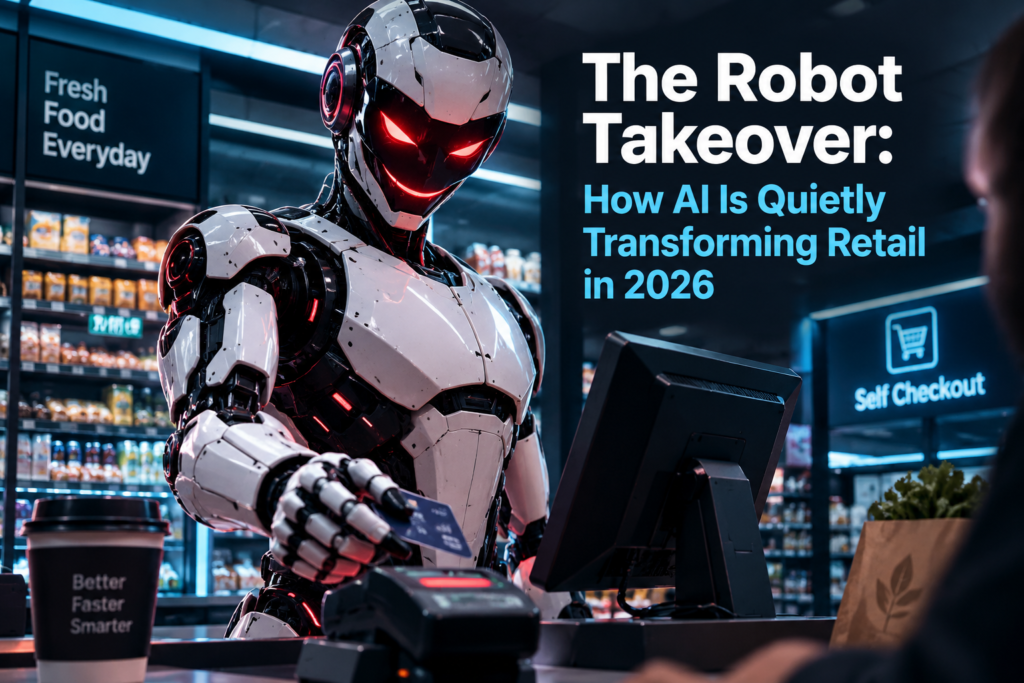
It’s a Tuesday morning at a Japanese convenience store. The sliding doors open. A customer walks in, grabs a coffee, and heads to the checkout. The register is empty. No cashier. Instead, a humanoid robot greets them with perfect eye contact, processes their payment in under 30 seconds, and says “Thank you, come again” with a smile that feels almost natural.
Two years ago, this would have felt like science fiction. Today, it’s not even news.
Across the globe—from Tokyo to California to Paris—retailers are deploying robots at a pace that would have seemed impossible in 2024. Not as experiments. Not as pilot projects. But as core infrastructure. And the numbers tell a story that’s impossible to ignore: the retail robotics market has already hit $23.7 billion in 2026, and it’s projected to reach $116.89 billion by 2035.
But here’s what most people are missing: This isn’t just about replacing workers. It’s about something far more profound. It’s about what happens when automation becomes the default, and legacy systems become instant liabilities.
Why Robots, Why Now?
The story of retail automation doesn’t start with innovation. It starts with desperation.
The U.S. retail sector had approximately 531,000 unfilled positions as of late 2025. Not thousands. Five hundred thousand. Retailers can’t hire enough people to staff their stores, even when they’re offering competitive wages. In high-cost-of-living areas like California, the math is brutal: minimum wage for fast-food workers reached $20 an hour in 2026. For retail workers, it’s $16.50 in many urban centers.
At those wage levels, the arithmetic of operating a traditional store falls apart fast:
• Average grocery store net profit margin: 1–3%
• Cashier annual cost (salary + benefits): $35,000–$50,000+
• 24/7 coverage requires: 5–6 full-time employees per position
• Total annual cost per checkout lane: $175,000–$300,000
A robot checkout system? $25,000–$100,000 upfront. No salary. No benefits. Works three shifts a day, every day, with zero complaints.
The decision wasn’t hard to make. It was inevitable.
What’s Actually Happening in Stores Right Now
Retail automation in 2026 looks different than most people imagine. It’s not one massive transformation. It’s a quiet, layered takeover happening simultaneously across multiple business functions.
Customer Service & Engagement
SoftBank’s Pepper robot is now deployed across 1,000+ Nestlé stores in Japan. Result: 15% increase in sales at equipped locations. Not because customers prefer robots. But because robots are infinitely patient, never tired, and can recommend products in 11 languages without losing focus.
HSBC deployed Pepper as a lobby concierge in branches. Result: customers get directed to the right desk faster, wait times drop, customer satisfaction climbs. The robot does one job—really well—and humans do the things that require judgment.
Inventory & Stock Management
This is where the real impact is happening. Bossa Nova robots now scan shelves in 50+ Walmart locations. These autonomous machines roll through the store 24/7, using computer vision to identify:
- Out-of-stock items (costing retailers lost sales)
- Misplaced products (reducing customer frustration)
- Expired inventory (preventing liability)
- Pricing discrepancies (catching employee errors or shrinkage)
Previously, a human employee would spend 2–4 hours per shift doing this work manually. Now? It happens continuously, automatically, with 99%+ accuracy. The data flows into the retailer’s system in real-time.
Logistics, Fulfillment & Back-of-Store Operations
This is where robots are making their fastest inroads. Figure AI just signed a deal with Catalyst Brands (JCPenney’s parent company) to deploy humanoid robots in a Reno, Nevada logistics hub. These robots are handling pick-and-pack operations—moving boxes, organizing inventory, managing goods—tasks that are repetitive, physically demanding, and dangerous.
Eden Robotics is now renting “robot employees” for just $10 an hour through their Theta OS platform. No upfront capex. No integration fees. Just plug in, train, and start.
The economic math is crystal clear. And retailers are responding by deploying robots at scale.
But Here’s What Nobody’s Talking About
Every store that deploys a robot is simultaneously generating a massive problem that most retailers haven’t even thought about yet.
Automation creates equipment churn. Churn creates data debt. Data debt creates liability.
Here’s the sequence:
Year 2: Upgrade robot models (better AI, faster processing, new capabilities). The old robots are now “obsolete.”
Year 3: Multiply by 1,000 stores. Then 5,000. Suddenly you have thousands of pieces of retiring infrastructure that still contain valuable data.
Year 4: Compliance question: “Where is all this old equipment? What data is on it? How was it handled?”
Most retailers have no answer. And that answer will cost them dearly.
The Data Lifecycle Crisis Nobody Sees Coming
Let’s walk through a real scenario. A major retailer deploys humanoid robots to 500 stores over two years. Each robot:
- Processes 200–500 customer transactions per day
- Logs detailed interaction data (customer behavior, product recommendations, timestamps)
- Generates inventory snapshots hourly
- Collects video/audio data for training model improvements
- Stores customer preferences, payment processing logs, repeat visit patterns
At scale, this is petabytes of data. Most of it sensitive. All of it valuable.
After 18 months, the retailer upgrades the robots. New model. Better AI. But the old robots—the ones from 2024—are now “legacy equipment.” What happens to them?
This is where things get risky:
The data on those systems includes:
- Customer payment information (PCI DSS compliance required)
- Video/audio from customer interactions (privacy regulations)
- Inventory patterns (competitive intelligence)
- Customer behavioral data (GDPR, CCPA applicable)
If that equipment is sitting in a warehouse, unaccounted for, that’s a compliance gap. If it’s eventually sold to a third party without proper data destruction certification, that’s a breach waiting to happen. If it’s dumped in a landfill, that’s e-waste mismanagement—risking ESG audit failures and regulatory fines.
And retailers just starting automation deployments in 2026? They’re about to learn this lesson the hard way.
The Framework That Solves This (And Most Don’t Know It Exists)
Here’s what sophisticated organizations do: they plan the complete data lifecycle from day one.
This isn’t complicated. It’s systematic. It’s the same framework that manufacturing companies have used for decades when managing asset lifecycles. It has five phases:
Phase 1: Audit
What equipment do you actually have, and what data is on it? Before you can manage anything, you need to know what exists. Most retailers deploying automation for the first time have zero visibility into what data their robots are generating—where it’s stored, who has access, what compliance frameworks apply.
Phase 2: Classify
What data is actually sensitive, and for how long? Not all data is created equal. Payment information? Always sensitive, always regulated. Inventory patterns from 18 months ago? Potentially garbage. Customer video from a specific interaction? May have a retention requirement of 6 months, then it’s liability.
Phase 3: Optimize
Move data to the appropriate storage tier and delete what’s expired. This is where cost optimization happens. Compliance-expired data doesn’t need to be in active storage. It can be archived (cold storage = 80% cost reduction). Or deleted entirely (100% cost reduction if no retention requirement exists).
Phase 4: Retire
When equipment reaches end-of-life, handle it properly. This means certified data destruction (ensuring no data recovery is possible), documented proof of destruction, and compliance validation. One certificate of destruction is worth more than $100K in liability protection.
Phase 5: Recover
Extract value from retiring equipment instead of treating it as waste. Older robot models still have market value. Checkout systems, network infrastructure, storage arrays—these are assets, not garbage. Properly handled, a single store’s retiring automation equipment can be worth $50K–$200K in recovered value. For a chain of 500 stores? That’s $25M–$100M in recovered capital.
Most retailers are doing none of these phases. They deploy robots, use them, then figure out what to do with them when they’re done. That’s backwards. And expensive.
The Real Future of Retail Automation
Here’s what 2027–2028 will look like: Retailers who deployed robots in 2024–2025 are now facing the consequences of no lifecycle planning. They have warehouses full of “legacy” equipment. Compliance teams are asking uncomfortable questions. ESG audits are flagging e-waste exposure. And they’re scrambling to figure out what to do.
Meanwhile, sophisticated retailers—the ones deploying automation now—are making different choices. They’re asking: “What’s our exit strategy?” “What happens to this data when the equipment retires?” “How do we turn retiring hardware into an asset, not a liability?”
These retailers are building complete data lifecycles into their automation strategies from day one. Because they understand something fundamental:
The robots getting deployed in 2026 are incredible. They’re faster than humans. They’re more reliable. They work 24/7 without complaints. But they also generate data, they consume infrastructure, and they eventually retire. Managing that complete lifecycle is what separates retailers that thrive from retailers that get buried in compliance debt and e-waste liability.
What This Means for Your Organization
Whether you’re a retailer, a manufacturer, or a financial services company, automation is coming to your business. When it does, ask yourself these questions:
- Data Visibility: Do we know what data our automation systems are generating, where it’s stored, and what compliance frameworks apply?
- Lifecycle Planning: Do we have a plan for what happens to this equipment when we upgrade or retire it?
- Compliance Readiness: If a regulator asks us to prove that sensitive data from retired equipment was properly destroyed, can we produce a certificate of destruction?
- Cost Optimization: Are we capturing the value of retiring equipment, or are we treating it as waste and losing $50K–$500K+ per deployment?
- ESG Impact: Are we managing e-waste responsibly, or is it becoming an audit liability?
If you can’t answer these questions confidently, you’re not ready for automation. Or rather, you’re ready to deploy robots. But you’re not ready to manage them completely.
The Opportunity That Most Are Missing
Automation is accelerating because the economics are undeniable. Robots work cheaper, faster, and more consistently than humans ever will. That shift is real and irreversible.
But the organizations that win won’t be the ones that deployed robots first. They’ll be the ones that managed the complete lifecycle best.
That means:
- Understanding every piece of data your automation systems generate (Audit)
- Knowing exactly what’s sensitive and for how long (Classify)
- Moving data to cost-effective tiers and deleting what’s expired (Optimize)
- Properly retiring and certifying data destruction when equipment reaches end-of-life (Retire)
- Recovering capital from retiring equipment instead of dumping it (Recover)
This is the complete data lifecycle. And it’s not optional anymore. It’s table stakes for responsible automation.
If your organization is deploying automation—or planning to—you need a complete data lifecycle strategy before you deploy the first robot.
Let’s talk about how to build one that protects your compliance, optimizes your costs, and turns retiring equipment into an asset.
Get a Free Automation Lifecycle AuditThe robots are coming. Some are already here. But the real competitive advantage—the one that will matter in 2027 and beyond—belongs to the organizations that manage the complete data lifecycle while everyone else is just managing the robots.